PORTFOLIO BUILD · SYNTHETIC TEST DATA
Revenue Data Reconciliation & Anomaly Detection
How I designed a workflow that turns validation failures into reviewable explanations and routed alerts.
Scope: This is a portfolio implementation tested with synthetic data. It is not presented as a live client deployment, and no commercial impact is claimed.
The problem
Revenue reporting can lose trust when inconsistent identifiers, missing values, or unexpected amounts pass from an extract into a forecast or leadership report. A useful monitor needs to show which records failed a check and give the owner enough context to investigate.
The goal for this build was to demonstrate a small, understandable path from a data quality rule to a human review—not to make an autonomous financial decision.
What the workflow does
- 01 · CHECK
Apply explicit validation rules
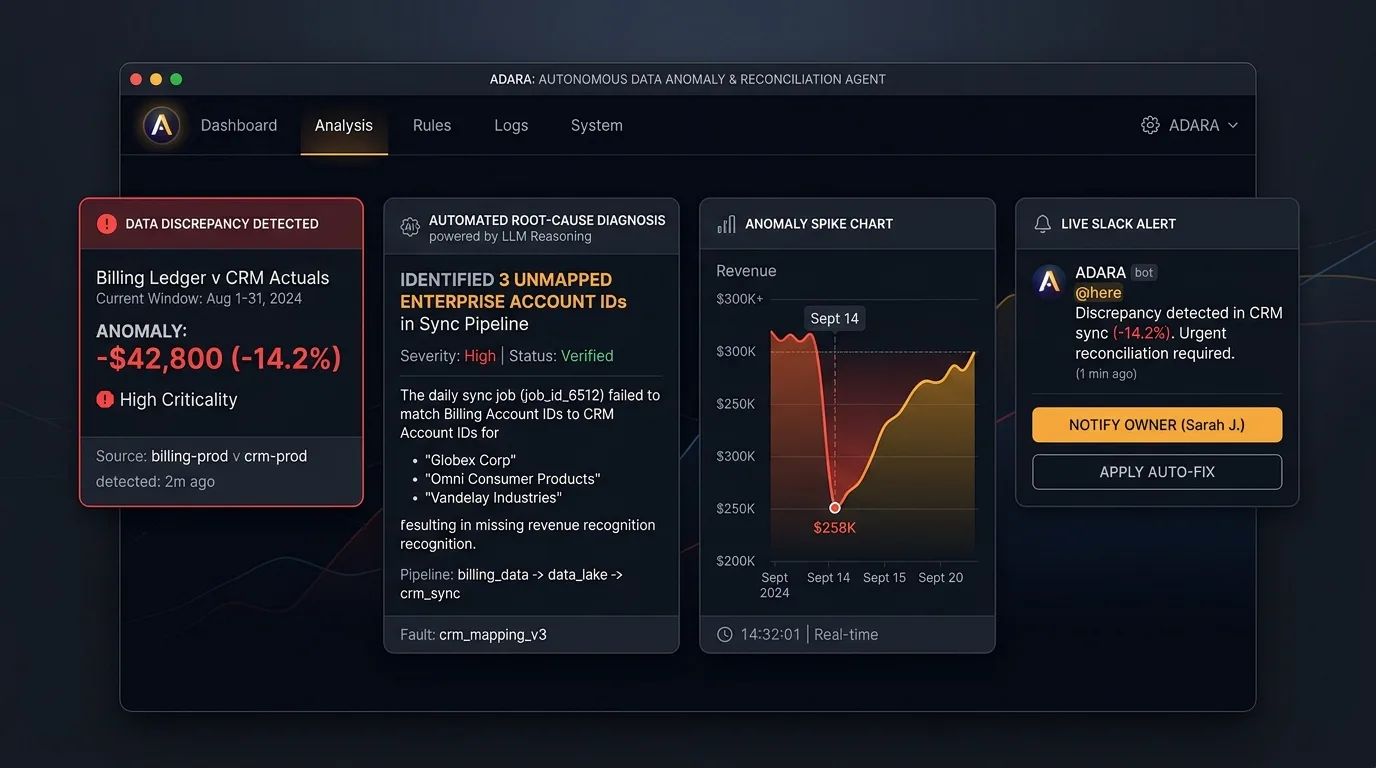
Google Apps Script checks a revenue extract for configured conditions and marks rows that need review.
- 02 · TEST
Exercise known anomalies
A synthetic dataset contains deliberately planted errors, so expected detections can be compared with actual flags without exposing business records.
- 03 · EXPLAIN
Add a readable explanation
An AI reasoning layer drafts a plain-language explanation for a flagged row. The explanation supports investigation; it does not replace the underlying rule or human review.
- 04 · ROUTE
Send the alert to an owner
Slack and email routing are included in the design so a finding can reach the people responsible for resolving it.
What is demonstrated—and what is not
The documented outputs are a rule-based detection flow, an anomaly test dataset, a generated explanation, and an alert path. These are implementation details a reader can inspect in the accompanying portfolio material.
No precision or recall score, time saved, reduction in data errors, or revenue lift is published for this build. Those results would need a recorded test report or a customer-approved production baseline before being stated as measured outcomes.
What a production rollout would require
- Agree on trusted source tables, definitions, and data owners.
- Set thresholds with business owners and test false positives against historical examples.
- Restrict data access and avoid sending sensitive values to an external model.
- Record a baseline and monitor precision, time to resolution, and downstream impact.